SME IPO ADVISORY — APRIL 2026
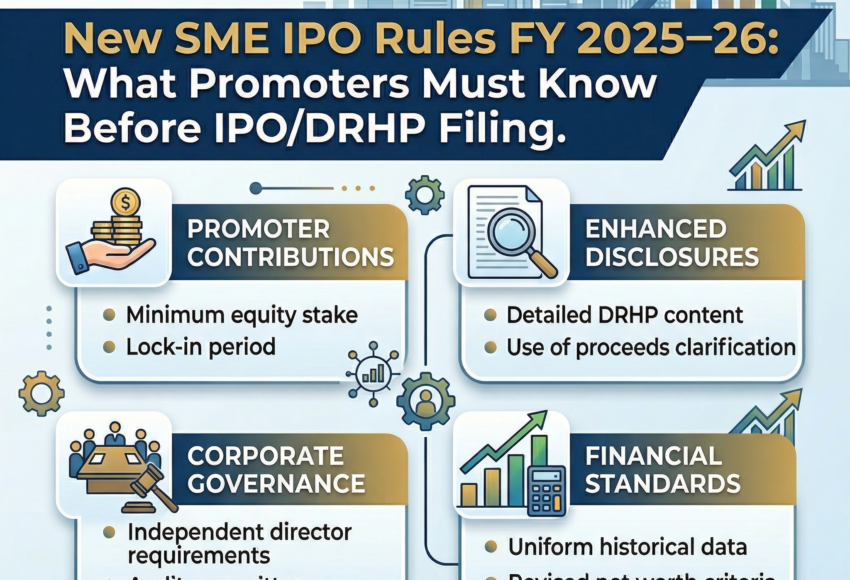
New SME IPO Rules 2025–26:
What Gujarat Promoters Must Know Before IPO/DRHP Filing
A plain-language guide to SEBI’s 2025–26 rule changes — eligibility, lock-in, OFS caps, fund-use restrictions, expanded Demat mandates, RPT compliance, and the new bidding process.
CS Monika Bhatia, FCS, LLM | M.R. Bhatia & Co., Company Secretaries, Ahmedabad
⚠ IMPORTANT — Regulatory Basis of This Guide (Updated April 2026)
This guide incorporates:
(1) SEBI ICDR Amendment Regulations, 2025 (notified 3 March 2025) — core SME IPO reforms.
(2) SEBI ICDR Second Amendment, 2025 (September 2025) — expanded demat mandate covering promoter group, KMPs, directors, selling shareholders, QIBs, employees, and regulated entities; founders may retain ESOPs (SBEB Amendment).
(3) SEBI ICDR Third Amendment, 2025 (31 October 2025) — anchor investor reforms.
(4) SEBI LODR Amendment, 2025 (27 March 2025) — RPT compliance for SME-listed entities w.e.f. 1 April 2025.
(5) SEBI LODR Fifth Amendment, 2025 (19 November 2025) — graded/turnover-linked RPT materiality thresholds.
(6) SEBI LODR Sixth Amendment, 2025 (16 December 2025) — further refinements.
(7) SEBI LODR Amendment, 2026 (20 January 2026) — HVDLE restructuring, mandatory demat for investor services.
(8) NSE/BSE Circulars dated 18 June 2025 — new SME IPO bidding process effective 1 July 2025.
Any DRHP filed after these dates must comply with the updated framework in its entirety.
Section 1 — Why Did SEBI Change the Rules?
Gujarat has been one of India’s most active SME IPO states, with companies from steel, chemicals, textiles, engineering, and diamond processing regularly listing on NSE Emerge and BSE SME. But rapid market growth also brought problems SEBI could no longer ignore:
| 245× Applicant-to-allotted investor ratio in FY 2023–24 — up from just 4× in FY 2021–22. | 196 SME IPOs in FY 2023–24, raising over ₹6,000 crore — the highest ever. |
| 57% Of SME IPOs in FY23–25 had OFS exceeding 20% — promoters cashing out. | 50% Of SME companies had RPTs above 10% of turnover — a governance red flag. |
Good News for Honest Promoters
Fewer speculative listings means more serious investor attention for quality companies. If your books are clean and your business is sound, the new rules work in your favour.
Section 2 — The 10 Key Changes, Explained Simply
Here is every significant rule change — what it was before, what it is now, and what it means for your company. Changes [1]–[8] flow from the SEBI ICDR amendments; changes [9]–[10] from the SEBI LODR amendments.
[1] Minimum Profitability — EBITDA of ₹1 Crore — NEW RULE
Before: No minimum EBITDA required → Now: ₹1 crore EBITDA in 2 of last 3 FYs
→ Check your EBITDA for FY 2022–23, FY 2023–24, and FY 2024–25
→ Two of these three years must individually cross ₹1 crore
→ EBITDA ≠ Net Profit — companies with high depreciation or interest may qualify even if net profit looks modest
→ One poor year is acceptable — two weak years means planning your IPO for a later year
Bottom line: Run this calculation before approaching any merchant banker. If you don’t qualify today, plan for the year you will.
[2] OFS Cap — IPO Cannot Be Purely a Promoter Exit — TIGHTER
Before: No cap on OFS portion → Now: OFS ≤ 20% of total issue size
→ At least 80% of your issue must be a fresh issue — new shares to raise capital for the company
→ Shareholders with >20% pre-IPO holding (fully diluted) cannot offer more than 50% of their holding
→ Shareholders with <20% pre-IPO holding cannot offer more than 10% of their holding
→ The IPO must primarily serve company growth, not personal liquidity
Bottom line: If you were planning a large OFS, restructure your issue design before engaging a merchant banker.
[3] Promoter Lock-In — Phased Release of Excess Holdings — PHASED
Before: Excess promoter holding locked 1 year → Now: 50% released at 1 yr, 50% at 2 yrs
→ MPC (20% of post-issue capital) remains locked for 3 years — unchanged
→ Promoter shares above MPC: 50% unlocked after Year 1, remaining 50% after Year 2
→ ESOP/SARs-based allotments and bonus shares on ESOP allotments now exempt from lock-in (March 2025)
→ Where majority of IPO proceeds are for capex, longer lock-in on residual promoter holding applies
Bottom line: Plan liquidity in three horizons: Year 1 (MPC locked + 50% excess), Year 2 (50% excess released), Year 3 (MPC released).
[4] No Promoter Loan Repayment from IPO Proceeds — STRICT
Before: Allowed with disclosure in DRHP → Now: Completely prohibited — no exceptions
→ IPO proceeds cannot repay loans from promoters, promoter group, or related parties
→ Audit all inter-party loans on your balance sheet before engaging a merchant banker
→ Unsecured promoter loans must be repaid from internal accruals or converted to equity before DRHP filing
→ Bank loans and third-party institutional debt can still be repaid from IPO proceeds
Bottom line: If your balance sheet has promoter/related-party loans earmarked for IPO repayment, this is your most urgent pre-IPO task.
[5] GCP Cap Tightened — Less Room for Vague Fund Use — TIGHTER
Before: Up to 25% for General Corporate Purpose → Now: 15% of issue or ₹10 crore, whichever lower
→ The remaining 85%+ of IPO proceeds must go to specific, named, measurable objects
→ Objects must be quantified: machinery purchase, capacity expansion, specific debt repayment, working capital
→ If working capital exceeds ₹5 crore as an IPO object, a separate auditor certificate is required
→ Exchanges will scrutinise vague objects during DRHP review
Bottom line: Build a detailed, project-specific use-of-proceeds statement with your CFO and CS before approaching the merchant banker.
[6] Monitoring Agency Now Required from ₹50 Crore Issue Size — NEW THRESHOLD
Before: Monitoring agency required above ₹100 Cr → Now: Required above ₹50 Cr; auditor certifies below
→ Issue ≥ ₹50 crore: appoint a SEBI-registered Credit Rating Agency as Monitoring Agency
→ Issue < ₹50 crore: statutory auditor must certify fund usage in every quarterly result
→ All promoter group transactions during IPO process disclosed to exchange within 24 hours
→ Pre-IPO placements disclosed in draft documents also reported to exchanges within 24 hours (March 2025)
Bottom line: Post-IPO fund monitoring is now mandatory and independent. Budget for this cost.
[7] Cooling-Off Period for Converted Companies & New Promoters — NEW RULE
Before: No cooling-off period required → Now: 1-year wait in both applicable cases
→ If converted from LLP, partnership, or proprietorship — complete at least 1 full FY before filing DRHP
→ If complete promoter change, or new promoters acquired >50% of shares — 1-year wait
→ Particularly relevant for Gujarat family businesses that restructured recently
→ Verify your exact conversion or acquisition date with your CS
Bottom line: If your company converted from LLP in FY 2025–26, your earliest DRHP filing is after completing that full financial year.
[8] New Bidding Process — Minimum Application Now ₹2 Lakh — EFFECTIVE JUL 2025
Before: Min. application: 1 lot (~₹1 lakh) → Now: Min. 2 lots (value > ₹2 lakh)
→ Effective 1 July 2025 (NSE/BSE Circulars dated 18 June 2025)
→ ‘Retail Individual Investor’ replaced by ‘Individual Investor’ (up to 2 lots, min. ₹2 lakh)
→ Cut-off price option removed; downward modification and cancellation not permitted
→ Bidding closes at 4:00 PM on final day for all categories
→ DRHP open for public comments for 21 days with QR code link in newspapers
Bottom line: Don’t compare subscription numbers to pre-2025 benchmarks. Quality investors at 20× is better than speculative noise at 500×.
[9] Expanded Demat Mandate — Beyond Promoters — NEW (SEP 2025)
Before: Only promoter shares required in demat → Now: Demat mandatory for promoters, promoter group, directors, KMPs, senior mgmt, QIBs, employees, selling shareholders & regulated entities
→ SEBI ICDR Second Amendment (Sep 2025) amended Reg 7(1)(c) and SME provision Reg 230(1)(d)
→ All specified securities of these categories must be dematerialised before DRHP filing
→ Foreign employees and moving cap tables between DRHP and RHP require advance planning
→ Begin demat conversion well before IPO timeline starts — 3–6 months lead time recommended
Bottom line: Map every shareholder category against the expanded demat mandate. Start conversions early to avoid delays.
[10] RPT Compliance for SME-Listed Entities (Post-Listing) — NEW (APR 2025)
Before: SME-listed entities exempt from Reg 23 (RPT) → Now: Reg 23 applies if paid-up capital > ₹10 Cr or net worth > ₹25 Cr
→ Effective 1 April 2025 (SEBI LODR Amendment, 27 March 2025)
→ Materiality threshold: ₹50 crore or 10% of annual consolidated turnover, whichever lower
→ LODR Fifth Amendment (Nov 2025): graded/turnover-linked RPT materiality for all listed entities
→ Compliance within 6 months of crossing threshold; remains applicable until 3 consecutive FYs below threshold
→ Audit committee must approve all material RPTs; subsidiary RPT oversight expanded
Bottom line: If your company will cross ₹10 Cr paid-up capital or ₹25 Cr net worth post-listing, budget for RPT compliance infrastructure immediately.
Section 3 — Pre-Filing Eligibility Checklist
Run through this before engaging a merchant banker. Any failure in a Mandatory row must be resolved first. Updated to reflect all SEBI ICDR amendments through March 2026.
| Parameter | Requirement (as amended to March 2026) | Applies To | Ready? |
| Company Structure | Must be a Public Limited Company | Mandatory | ☐ Yes / ☐ No |
| Post-Issue Paid-Up Capital | ≤ ₹25 crore (above = mainboard) | Mandatory | ☐ Yes / ☐ No |
| Track Record | Minimum 3 years of operation | Mandatory | ☐ Yes / ☐ No |
| EBITDA (2025) | ≥ ₹1 Cr in 2 of last 3 FYs | Mandatory | ☐ Yes / ☐ No |
| FCFE | Positive in 2 of last 3 FYs | NSE Only | ☐ Yes / ☐ No |
| Net Worth | Positive; min. ₹1 Cr in preceding 2 yrs | Mandatory | ☐ Yes / ☐ No |
| Net Tangible Assets | ≥ ₹3 crore in last full FY | Mandatory | ☐ Yes / ☐ No |
| Leverage Ratio | Up to 3:1 | Mandatory | ☐ Yes / ☐ No |
| No Loan Defaults | Clean record for last 3 years | Mandatory | ☐ Yes / ☐ No |
| Promoter Debarment | No SEBI debarment on any promoter/director/selling shareholder | Mandatory | ☐ Yes / ☐ No |
| Promoter Loan Cleanup | No promoter/RP loans repayable from IPO proceeds | Mandatory | ☐ Yes / ☐ No |
| Expanded Demat (Sep 2025) | Promoters + promoter group + directors + KMPs + sr. mgmt + QIBs + employees + selling shareholders in demat | Mandatory | ☐ Yes / ☐ No |
| Cooling-Off (Conversion) | If converted from LLP/Partnership, ≥ 1 full FY elapsed | If Applicable | ☐ Yes / ☐ No |
| Cooling-Off (Promoter Change) | If >50% acquired by new promoters, 1-year wait | If Applicable | ☐ Yes / ☐ No |
| Compliance Officer | Must be a qualified Company Secretary | Mandatory | ☐ Yes / ☐ No |
| No Outstanding Convertibles | Except ESOPs and exercised SARs | Mandatory | ☐ Yes / ☐ No |
| Promoter ESOPs (Sep 2025) | Founders as promoters may retain ESOPs granted ≥1 yr before DRHP | If Applicable | ☐ Yes / ☐ No |
Section 4 — BSE SME vs NSE Emerge: Which Platform?
Both platforms serve SMEs, but one critical difference matters for many Gujarat companies.
| Parameter | BSE SME | NSE Emerge |
| Post-issue capital | ≤ ₹25 crore | ≤ ₹25 crore |
| Track record | 3 years | 3 years |
| Minimum EBITDA | ₹1 Cr in 2/3 FYs | ₹1 Cr in 2/3 FYs |
| FCFE Requirement | ✗ Not required | ✓ Positive 2/3 FYs |
| Net worth | ≥ ₹1 Cr (2 yrs) | ≥ ₹1 Cr (2 yrs) |
| Net tangible assets | ≥ ₹3 crore | ≥ ₹3 crore |
| Demat mandate | Expanded (Sep 2025) | Expanded (Sep 2025) |
| DRHP filed with | BSE Exchange | NSE Exchange |
| Market making | 3 years mandatory | 3 years mandatory |
| RPT (post-listing) | If capital >10 Cr / NW >25 Cr | If capital >10 Cr / NW >25 Cr |
The FCFE Rule — Critical for Gujarat Manufacturers
Many capital-intensive Gujarat businesses (engineering, steel, chemicals, textiles) have strong EBITDA but negative FCFE due to heavy CAPEX cycles. If your FCFE is negative in 2 of the last 3 years, BSE SME is likely the more accessible platform. Discuss this with your CS before selecting an exchange.
Section 5 — The SME IPO Journey: Step by Step
From decision to listing. Most Gujarat SMEs complete this in 9–18 months, depending on readiness.
Step 1 Eligibility Check & Financial Readiness
Run the Section 3 checklist. Verify EBITDA, net worth, FCFE, inter-party loans. Map all shareholders against the expanded demat mandate. Engage a Practising CS for a pre-IPO health check.
⏱ 2–4 weeks
Step 2 Corporate Restructuring & Pre-IPO Cleanup
Convert to public limited (if needed), dematerialise all stakeholder shares (expanded Sep 2025 mandate), clean up inter-party loans, restructure board, appoint qualified CS as compliance officer.
⏱ 2–6 months
Step 3 Appoint SEBI-Registered Merchant Banker
Merchant banker conducts due diligence, prepares DRHP, arranges underwriting. All pre-IPO placements and promoter group transactions reported to exchanges within 24 hours.
⏱ 1–2 months
Step 4 Prepare & File DRHP with Exchange
DRHP filed with BSE SME or NSE Emerge (not SEBI). Open for public comments for 21 days from date of public announcement with QR code in newspaper ads.
⏱ 2–3 months
Step 5 Exchange Review, Site Inspection & Approval
Exchange reviews DRHP, conducts site visit, convenes Listing Advisory Committee before issuing in-principle approval.
⏱ 2–3 months
Step 6 File RHP, Roadshows & IPO Opens
Final prospectus filed with ROC. Roadshows with HNIs and institutions. IPO opens 3 days; min. application 2 lots (>₹2 lakh). Bidding closes 4 PM final day. No cut-off price.
⏱ 4–8 weeks
Step 7 Allotment & Listing
Shares allotted; trading begins on BSE SME or NSE Emerge.
⏱ ~6 days after close
Step 8 Post-Listing Compliances
Quarterly results, RPT disclosures (if applicable per LODR thresholds), fund utilisation certifications, market making for 3 years, SEBI LODR filings, secretarial audit.
⏱ Ongoing (3+ years)
Section 6 — 7 Mistakes Gujarat Promoters Make Before Filing
✗ Not cleaning up inter-party loans first
Many companies discover too late that promoter loans cannot be repaid from IPO proceeds. Restructuring requires months and delays the entire timeline.
✗ Confusing EBITDA with Net Profit
The profitability test is EBITDA-based, not PAT-based. A company with high depreciation can qualify on EBITDA even with modest net profit — and vice versa.
✗ Converting from LLP and filing immediately
After converting from an LLP or partnership, the cooling-off period requires one full FY to pass before filing.
✗ Choosing a merchant banker solely on cost
The lead manager’s investor relationships and exchange committee experience directly determine listing success.
✗ Ignoring the expanded demat mandate
Since September 2025, demat is required for promoter group, directors, KMPs, senior management, QIBs, employees, and selling shareholders. Failing to plan early — especially for foreign employees or dissenting shareholders — delays DRHP filing significantly.
✗ Ignoring post-listing RPT compliance
If your company crosses ₹10 Cr paid-up capital or ₹25 Cr net worth post-listing, full RPT governance under Regulation 23 applies. Budget for audit committee infrastructure and RPT approval processes from day one.
✗ Vague fund-use objects in the DRHP
With the GCP cap at 15%, objects must be specific and quantified. Generic language no longer passes exchange review.
Section 7 — Frequently Asked Questions
Q: Can a private limited company directly apply for an SME IPO?
No. Only a public limited company can apply. After conversion, you must complete at least one full financial year before filing the DRHP — a requirement introduced in the 2025 amendments.
Q: What is the minimum EBITDA required?
A minimum EBITDA of ₹1 crore for at least 2 out of 3 financial years immediately preceding filing. EBITDA is measured before interest, tax, depreciation and amortisation.
Q: Can IPO proceeds repay bank loans (not promoter loans)?
Yes — only the prohibition on repaying promoter/related-party loans is new. Bank, NBFC, and third-party lender loans can still be repaid from IPO proceeds if disclosed as an object of the issue.
Q: BSE SME or NSE Emerge — which should I choose?
NSE Emerge requires positive FCFE for 2 of the last 3 FYs. BSE SME does not. For capital-intensive Gujarat businesses with large CAPEX cycles, BSE SME is often more accessible.
Q: Is a Company Secretary mandatory?
Yes. The March 2025 SEBI ICDR amendments require the compliance officer to be a qualified CS, aligning the pre-IPO requirement with the SEBI LODR norm.
Q: Who needs to hold shares in demat form before DRHP?
Since September 2025: promoters, promoter group, selling shareholders, directors, KMPs, senior management, QIBs, domestic employees, SR shareholders, and entities regulated by financial sector regulators. The parallel SME provision under Reg 230(1)(d) extends this to SME IPOs.
Q: What RPT obligations apply after SME listing?
From 1 April 2025, SME-listed entities with paid-up capital >₹10 crore or net worth >₹25 crore must comply with Regulation 23 (RPT). Materiality threshold: lower of ₹50 Cr or 10% of annual consolidated turnover. The November 2025 LODR amendment introduced graded, turnover-linked materiality for all listed entities.
Q: Can founders classified as promoters retain ESOPs?
Yes. The September 2025 SEBI SBEB Amendment allows employees identified as promoters to continue holding options/SARs granted at least 1 year before DRHP filing.
Q: How long does the process take? For a well-prepared company: 6–12 months. For companies needing restructuring (LLP conversion, loan cleanup, expanded demat compliance, board reconstitution): 15–24 months.